
Kill The Credit Zombies
Stop illegal collection. Document violations. Get paid. Semper Fidelis!
What is a Credit Zombie?
When you default on debt, banks get paid through Credit Default Swap (CDS) insurance, take a tax deduction, charge it off, and sell the account to collectors for pennies. Your original debt is dead and gone, but collection agencies buy it for pennies, bring it back to life (Zombie Debt) and come after you for the full amount. The Federal law precludes from this action but because consumers don't know the law they get taken advantage of. It's called "double-dipping" or double recovery and it's ILLEGAL! You should demand they present an original contract between them and you....They could never produce that document due to the fact the original contract was between you and the original creditor, not them! You can actually countersue them for this action and get paid! See the details below.

Bank Paid #1
CDS Insurance Payout
Bank Paid #2
Tax Write-Off
Bank Paid #3
Charge-Off
Bank Paid #4
Sold to Collector
Zombie Debts
0
Already paid by CDS
SOL Expired
0
Too old to collect
TCPA Damages
$0
Potential claims
Asking you to pay more than you owe
Adding illegal interest/fees not in original contract
Calling repeatedly or continuously (harassment)
Using obscene/profane/abusive language
Calling before 8am or after 9pm
Calling at inconvenient times
Threatening violence if you don't pay
Threatening action they cannot/will not take
Illegally telling 3rd parties about your debt
Calling 3rd parties repeatedly for your location
Contacting you at work when employer disapproves
Failing to send written debt validation notice
Ignoring written request to verify debt
Continuing to collect before providing verification
Continuing collection after Cease & Desist
Claiming to be law enforcement / government
Falsely representing the amount owed
Impersonating a credit bureau member
Listing your debt for sale to the public
Falsely claiming you've committed a crime
TCPA Damages: $500-$1,500 per call!
Every unauthorized robocall/auto-dialer call = $500 (negligent) to $1,500 (willful) per violation. These add up FAST. Document every call with date and time!
No threats logged. Document every contact — it's your ammunition!
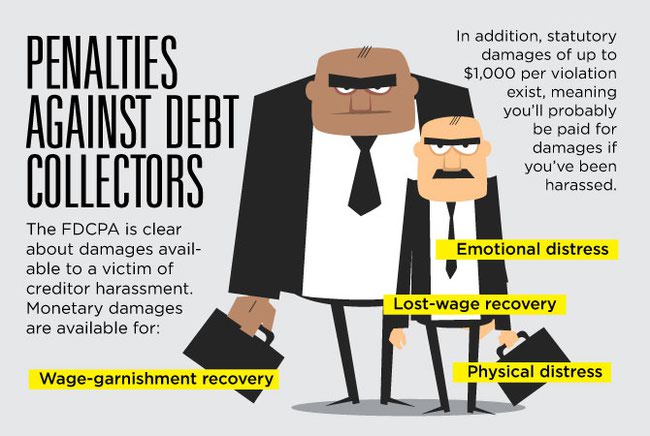
They've been coming after YOU. Now it's YOUR turn. The FDCPA gives you the power to sue debt collectors and WIN real money damages.
💰 What the FDCPA Says You Can Win
Statutory Damages
Per lawsuit — automatic if any FDCPA violation is proven. No actual harm required.
Actual Damages
Compensation for real losses: lost wages, out-of-pocket expenses, harm to credit.
Emotional Distress
Stress, anxiety, sleeplessness caused by illegal harassment can be compensated.
Physical Distress
Physical manifestations of distress from collector harassment (headaches, illness, etc.).
Lost-Wage Recovery
If harassment caused you to miss work or lose income, you can recover every dollar.
Wage-Garnishment Recovery
Illegal garnishment of wages can be reversed and recovered in full.
TCPA Robocall Damages
Every illegal robocall or auto-dialer call is a separate violation. These add up FAST.
Court Costs Covered
If you win, the debt collector is required to pay all court costs. It costs you nothing to fight.
🎯 How to Sue a Debt Collector — Step by Step
Document EVERY Contact
Log dates, times, what was said. Screenshot texts/voicemails. This is your evidence.
Send a Cease & Desist Letter
Certified mail only. Once received, they MUST stop all contact. Any contact after = automatic violation.
Send a Debt Validation Letter
Within 30 days of first contact. Demand original contract, chain of title, proof they own the debt.
File a CFPB Complaint
Go to consumerfinance.gov. Federal pressure often forces immediate action and creates a paper trail.
File an FTC Complaint
reportfraud.ftc.gov — adds federal teeth to your case and builds a national record against the agency.
File an Attorney General Complaint
Your state AG can investigate and fine them. Some states have stronger laws than the federal FDCPA.
File in Federal or Small Claims Court
Federal court: up to $1,000 statutory + actual damages. Small claims: fast, cheap, no attorney needed for smaller amounts.
"They counted on you being scared and uninformed. The moment you pick up that pen and write that first letter — YOU become the threat. They don't want to see you in court. GO THERE ANYWAY."
— Drill Sgt. J. L. King, Jr.
These are the exact, court-tested legal instruments attorneys charge $500–$2,500 EACH to prepare. Your toolkit includes them all — fully formatted and ready to deploy. This is firepower the average consumer could never afford. Until now.
Attorney Cost vs. Your Toolkit
A single FDCPA demand letter from a lawyer: ~$350. The full arsenal below from a credit-repair firm: $1,500–$5,000+. Your one-time toolkit price: $14.99.
$5,000+
$14.99
Cease & Desist Letter
15 U.S.C. § 1692c(c) — FDCPA
Forces: Once a collector receives this in writing, they MUST stop ALL communication with you — with the sole exception of notifying you of a specific legal remedy they actually intend to pursue. Any further contact is an automatic, actionable violation worth up to $1,000 + actual damages + attorney fees.
When to deploy: Deploy the moment a collector harasses you. Certified mail, return receipt requested. It is your single most powerful "shut up" button under federal law.
Validation of Debt Demand
15 U.S.C. § 1692g — FDCPA § 809
Forces: Forces the collector to PROVE the debt is yours. They must produce the original signed contract, a complete chain of title showing they legally own the account, and a full accounting of the amount claimed. If they cannot — and zombie-debt buyers almost never can — collection activity MUST cease and the debt is unenforceable.
When to deploy: Send within 30 days of their FIRST contact with you. This triggers their legal obligation to validate before they can continue collecting.
FCRA § 611 Reinvestigation Demand
15 U.S.C. § 1681i — FCRA
Forces: Compels the credit bureaus (Equifax, Experian, TransUnion) to investigate your dispute within 30 days. If they cannot verify the item with the furnisher, federal law REQUIRES them to delete it from your report. No verification = no reporting. Period.
When to deploy: Use for any inaccurate, incomplete, unverifiable, or outdated item on your credit report. File with all three bureaus simultaneously for maximum pressure.
FCRA § 605 Obsolete Information Removal
15 U.S.C. § 1681c — FCRA
Forces: Most negative information CANNOT be reported after 7 years (bankruptcies after 10 years, unpaid tax liens after 7). This demand forces the bureaus to delete anything older than the legal limit. Many "zombie" debts are past this window and are illegally re-aged by collectors.
When to deploy: Any negative item approaching or past the 7-year mark. Re-aging is a separate FCRA violation worth statutory + actual damages.
Direct Creditor Challenge
15 U.S.C. § 1681s-2 — FCRA § 623
Forces: Goes straight to the SOURCE — the original creditor or furnisher — and forces THEM to investigate and correct inaccurate info they reported. If they fail to conduct a reasonable investigation, they become liable to you for actual damages plus statutory penalties up to $1,000 per violation.
When to deploy: When the bureau "verifies" an item you know is wrong, bypass the bureau and hit the furnisher directly. This is the move most consumers never make.
Affidavit of Creditor Dolus
Sworn Affidavit — Federal Rules of Civil Procedure
Forces: A sworn, notarized statement documenting the creditor's fraud, deceit, or misrepresentation. Under FRCP, an unrebted affidavit stands as evidence in court. If the collector cannot produce a counter-affidavit (and they cannot, because the debt is a zombie), your affidavit becomes the record of fact.
When to deploy: When you have documented evidence of double-recovery, re-aging, or misrepresentation. This converts your documentation into court-admissible evidence.
Conditional Acceptance
Contract Law — UCC § 1-103
Forces: You conditionally ACCEPT their demand for payment — UPON their proof of a valid contract between THEM and YOU, proof of consideration, and proof of damages. Since zombie-debt buyers have no contract with you, they default on the conditions and your conditional acceptance becomes a discharge of the claim.
When to deploy: A powerful response to any collection demand letter. It flips the burden of proof entirely onto them.
CFPB Complaint
Consumer Financial Protection Bureau — 12 U.S.C. § 5493
Forces: A federal complaint that the CFPB routes directly to the company and makes public. The CFPB has the power to investigate, fine, and order restitution. Companies respond fast to CFPB complaints because federal oversight and public record are on the line.
When to deploy: After the collector violates the FDCPA or fails to validate. File at consumerfinance.gov — it is free, fast, and creates an official federal paper trail.
FTC Threat Letter / ReportFraud
Federal Trade Commission — 15 U.S.C. § 57a
Forces: Escalation to the FTC builds a national enforcement record against the agency. The FTC can bring enforcement actions and refer cases for prosecution. This letter notifies the collector that their conduct is now on the FTC's radar.
When to deploy: For repeat or egregious violations. File at reportfraud.ftc.gov and reference the complaint in your demand letter.
Attorney General Complaint
State Consumer Protection Statutes
Forces: Your state Attorney General can investigate, mediate, and bring state-level enforcement actions. Many states have consumer-protection laws STRONGER than the federal FDCPA, with higher statutory damages. The AG letter often produces faster results than federal routes.
When to deploy: After FDCPA violations, especially if the agency operates in your state. Some AG offices have dedicated consumer-protection units that pursue collectors aggressively.
⏱️ Statute of Limitations — The Zombie Killer
Every debt has a legal expiration date. After it passes, the debt is time-barred — they can NEVER legally force you to pay, and suing you for it is itself an FDCPA violation. Many zombie debts are already past this limit; collectors bank on you not knowing.
Oral Agreements
3–6 yrs
Written Contracts
3–6 yrs
Promissory Notes
3–15 yrs
Open Accounts (Cards)
3–6 yrs
Limits vary by state — verify your state's statute before responding. NEVER acknowledge or pay a time-barred debt; doing so can RESTART the clock.
"An attorney would charge you thousands to draft these. I'm handing you the loaded weapons and teaching you how to aim. These documents are why I beat Equifax in court — and why you will too. USE THEM."
— Drill Sgt. J. L. King, Jr.
Encore Capital Group
CFPB ordered $42M repayment + $10M penalty
Portfolio Recovery Associates
CFPB fined $24M for repeat violations
Enhanced Recovery (ERC)
Known aggressive tactics
Convergent Resources
Multiple FDCPA violations
Synchrony Financial
Watch for illegal practices
AFNI/Anderson Financial Network
Specializes in cell/DirectTV debt
Resurgent Capital Services
High complaint volume
Transworld Systems
Multiple consumer complaints